
What is dry ice cleaning? Complete guide
You have heard of dry ice cleaning or dry ice blasting and wonder what it actually is? This technology is transforming industrial maintenance by cleaning equipment with no water, no chemicals and no dismantling. In this complete guide, we explain everything: how it works, benefits, applications and costs.
In short: dry ice cleaning consists of blasting dry ice (solid CO₂) at high speed onto the surface to be cleaned. The ice sublimates instantly, removing deposits without damaging the surface and without leaving any residue.
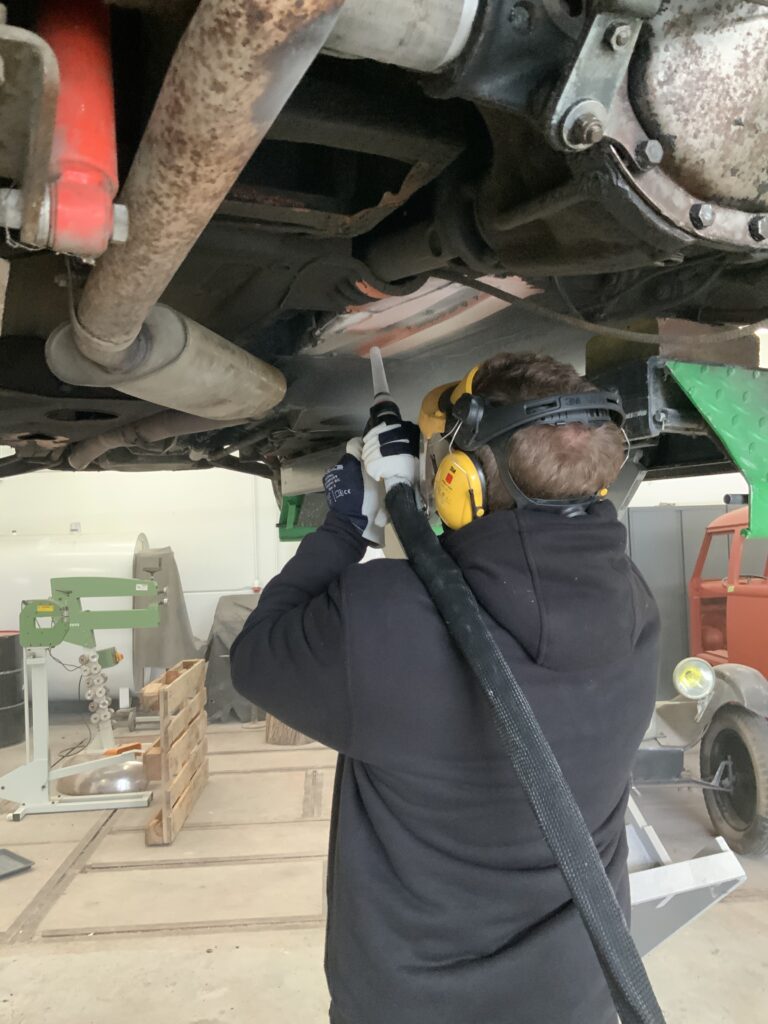
Full stripping and cleaning of a chassis by dry ice blasting.
How does dry ice cleaning work?
Dry ice cleaning is based on a simple physical principle: sublimation. Dry ice (solid CO₂) is blasted at very high speed onto the surface using compressed air. On contact with the surface, three effects occur at the same time:
- Thermal effect: dry ice is at −78.5 °C. The thermal shock between the ice and the surface micro-fractures the deposit to be cleaned.
- Mechanical effect: the high-speed blasting of ice particles creates a kinetic impact that lifts the residue.
- Sublimation: the ice turns directly from solid to gas. Zero water, zero residue, zero liquid waste.
All that remains are the loosened deposits, which are easily vacuumed or swept up. The equipment is clean, dry and ready to restart immediately.
The benefits of dry ice cleaning
What sets dry ice cleaning apart from traditional methods is a combination of unique benefits that makes it the preferred solution of industrial maintenance managers.
No water
Unlike pressure or steam cleaning, dry ice blasting uses no water. This removes any risk of corrosion, short circuits or microbiological contamination. Ideal for electrical cabinets, moisture-sensitive equipment and clean rooms.
No chemicals
No detergent, no solvent. Dry ice is classified as E290 (food additive): it is completely inert and safe for food, pharmaceutical or electronic surfaces. Zero chemical waste to process.
No dismantling
One of the most decisive benefits for industry: equipment is cleaned in place, without dismantling. No risky reassembly, no lost parts, no need for a specialist technician to put everything back together.
Less downtime
Companies that adopt dry ice cleaning see up to a 70% reduction in maintenance downtime compared with traditional methods. The machine is clean and restarts immediately after the job.
Environmentally friendly
The CO₂ used is a by-product recovered from other industries: it is not produced specifically for cleaning. Using it does not add to net CO₂ emissions.
Which sectors use dry ice cleaning?
Dry ice blasting applies to a wide variety of sectors and equipment. Here are the main applications:
- Industry & production: production lines, presses, injection moulds, conveyors, machine tools
- Food industry: packaging lines, HACCP equipment, cold rooms, food conveyors
- Pharmaceuticals & laboratories: reactors, clean rooms, GMP equipment, packaging lines
- Buildings & heritage: facades, natural stone, historic monuments, timber structures
- Electrical & energy: electrical cabinets, distribution boards, live equipment (with a qualified operator from your team)
- Post-fire: soot removal, decontamination after a disaster, odour treatment
Dry ice cleaning vs other methods: the comparison
Compared with traditional methods, dry ice cleaning offers decisive advantages in most industrial situations:
- vs pressure washing: dry ice blasting leaves no residual water, does not risk damaging electrical components and needs no drying time.
- vs sandblasting: dry ice is non-abrasive, it does not scratch surfaces and produces no sand particles to remove.
- vs chemicals: no contact time needed, no rinsing, no liquid waste to process or pay for.
- vs manual cleaning: much faster, more effective in hard-to-reach areas and with no operator exposure to hazardous products.
How much does dry ice cleaning cost?
The cost of a job depends on several factors: the surface to be treated, the type of fouling, the accessibility of the equipment and the location. As a guide:
- Small job (electrical cabinet, engine): €200 to €500
- Industrial machine: €800 to €2,000
- Complete production line: €1,600 to €4,000
- Post-fire job: €1,600 to €6,000
These prices are indicative. Icetec offers a free, tailored quote within 6 hours, with no obligation. See our pricing page for more details.
Icetec, dry ice cleaning specialist in Belgium
Based in Namur, Icetec is a Belgian company specialising in industrial dry ice cleaning. We use the latest Cryonomic equipment and Air Products CO₂ dry ice for the best results.
Our certified technicians work throughout Belgium and Luxembourg, in every industrial sector: food, pharmaceuticals, energy, buildings and post-fire.
Have a project? Contact us for a free quote within 6 working hours.
Equipment to clean?
Describe your installation or send us a few photos: we’ll reply with an initial assessment and a free quote within 6 working hours.