
An excavator, a compactor or a concrete mixer truck spends its days in direct contact with cement, sprayed concrete, bitumen or lime. The result: hydraulic cylinders, tracks, bodies and buckets get covered in a hard crust that hardens over time. Many civil engineering companies push this cleaning down the list, until it becomes a real mechanical and financial problem.
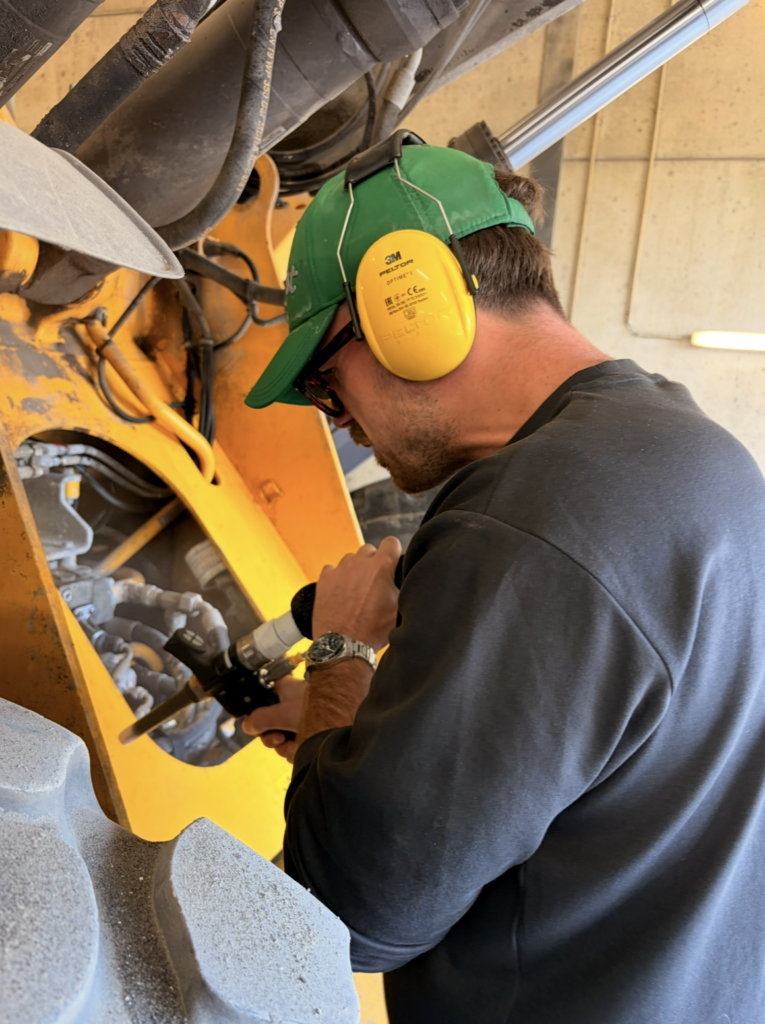
Why these hardened residues are a real mechanical problem
Concrete and cement harden chemically as they dry and bond very strongly to metal surfaces; bitumen and lime harden as they cool or carbonate, with the same gripping effect. Built up on hydraulic cylinders, they speed up the wear of seals and piston rods with every movement. On tracks and joints, this crust acts as an internal abrasive that wears moving parts much faster than normal use. On bodies, buckets and drums, it thickens by one layer with every job, until it reduces the useful capacity and distorts weighing or dosing.
Scraping, solvents, pressure washing: the limits of conventional methods
Manual scraping with a spatula or wire brush takes a considerable amount of time and always scratches paintwork and chrome surfaces. Solvents or strippers do break down some residues, but they carry risks for operators and are incompatible with the rubber seals and hydraulic hoses they weaken over time, especially on concrete and cement, where they often have no effect. The pressure washer only softens the surface of a crust that has already hardened, without ever removing it completely, while forcing water into joints and bearings where it promotes corrosion.
Dry ice cleaning: the crust comes off, the metal stays intact
Dry ice blasting removes concrete, cement, bitumen or lime through thermal shock: the extreme cold makes the crust rigid and brittle, and it comes off in sheets without any abrasive tool touching the metal. The process is completely dry (no water gets into cylinders, bearings or electrical connections) and solvent-free, so there is no risk to seals and hydraulic hoses. Spreader bars, bodies, buckets and track assemblies can be treated without full dismantling, which greatly limits machine downtime.
What it concretely changes for your fleet
A machine that is regularly cleared of residue keeps cylinders and joints that work without abrasive overload, which extends their service life and reduces unexpected hydraulic failures. Commercially, a clean machine inspires more confidence when rented out, and makes technical inspections and maintenance checks easier, since the real condition of the mechanical parts is no longer hidden by the crust. It is also a strong argument at resale: a visibly well-maintained machine leaves far less room for negotiation than an encrusted one, whose surface condition a potential buyer will use as leverage to lower the price. For a civil engineering company, it also projects the image of a professional fleet to clients and contractors.
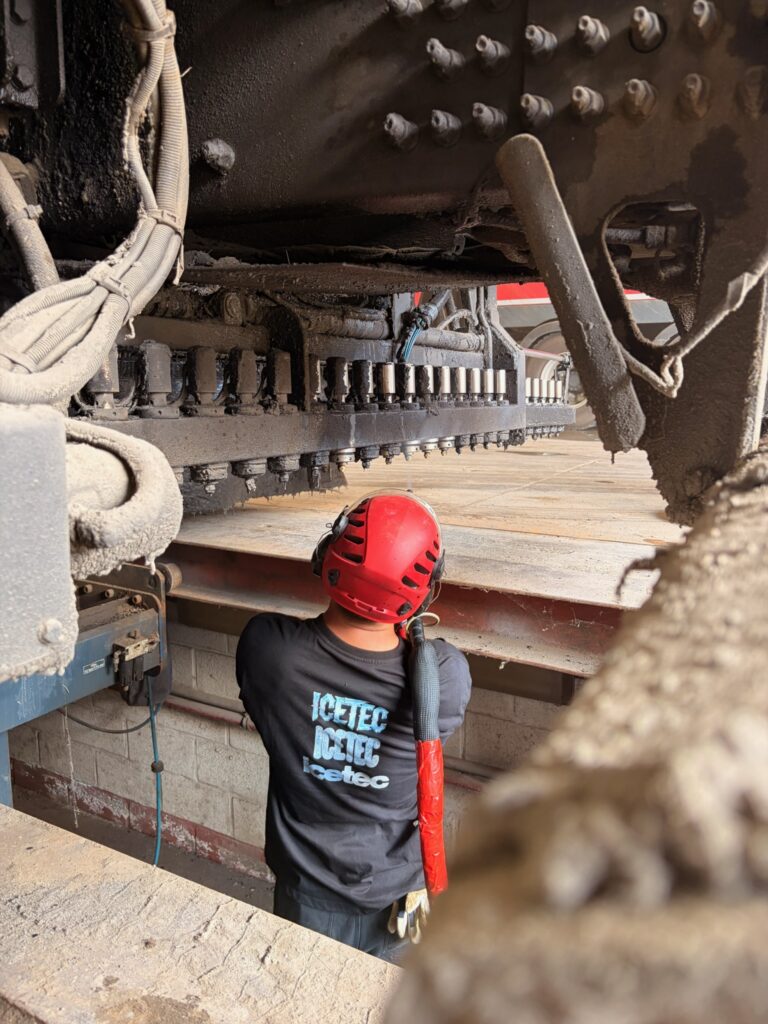
Technician cleaning the bitumen spreader bar under a truck
When to consider it first
Dry ice cleaning is particularly relevant before a resale or a return to the rental fleet, before a technical inspection or scheduled maintenance check, and as regular preventive maintenance for machines working continuously on earthworks, structural work or road sites. It suits excavators and compactors as well as concrete mixer trucks, spreading trucks and their spreader bars, whatever their size or the type of residue.
Icetec works on construction machinery in Belgium and Luxembourg, with a free quote within 6 working hours. See our prices or contact us directly to schedule a job on your fleet.
Equipment to clean?
Describe your installation or send us a few photos: we’ll reply with an initial assessment and a free quote within 6 working hours.